Explore depictions of marine life in the art of Late Bronze Age Greece (ca. 1600–1100 BC)! Amid a survey of sea creatures found in these works, including octopods, dolphins, and fish, special attention is given to the enigmatic argonaut motif and its appearance on wall paintings of the Mycenaean ‘Palace of Nestor’ at Pylos. While the focus is divided between the motif’s various meanings, its painted depictions offer exciting insight into the thought processes and working methods of Greek Bronze Age artists.
Watch the recording on YouTube.
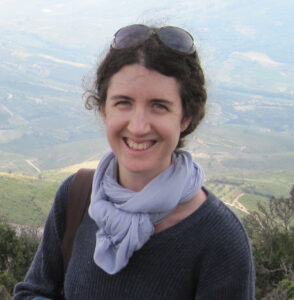 Emily Catherine Egan is Assistant Professor of Ancient Eastern Mediterranean Art and Archaeology in the Department of Art History & Archaeology at the University of Maryland. She holds a dual B.A. from Brown University in Classics and Old World Archaeology and Art, an M.Phil. in Archaeology from the University of Cambridge, and an M.A. and Ph.D. from the Department of Classics at the University of Cincinnati. She has conducted archaeological fieldwork in Italy, Turkey, Cyprus, Jordan, Armenia, and Greece, where she is currently involved in projects at the sites of Mycenae and Pylos. Her research focuses on painted surface decoration, and especially on the iconography of Greek wall and floor paintings from the late second millennium BC.
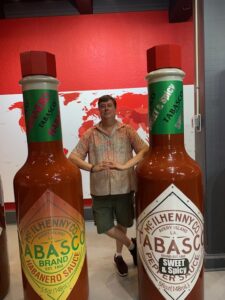 Dann Woellert is a Food Etymologist, studying the origin of our food customs and regional dishes. From discovering the region in northwest Germany where our Goetta originated, to breaking down the Cincinnati style three-way, Dann takes us on a journey of discovery and connection to our ancestors. For the last decade he has curated the blog Dann Woellert the Food Etymologist and has written eight books about Cincinnati Food History. He has recently been in five episodes of Season 4’s Food that Built America on the History Channel (streaming on Hulu and Amazon). He’s a history preservationist and is closely tied to several local organizations including the Delhi, Cheviot, Westwood, Price Hill, Milford, Loveland and Green Township Historical Society, the German Heritage and Over-the-Rhine Museums, and the Brewery Heritage Trail. Dann also teaches at UC’s Communiversity and has been seen dressed in Civil War uniform, as St. Nicholas, and as beer baron Fred Linck around town.
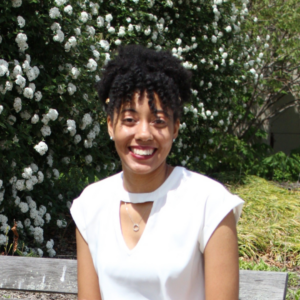 Jaeydah Edwards, Citizen Science Program Director for Groundwork Ohio River Valley, works to connect Cincinnati communities to their local environments through various programs and community engagement events. Some of her work includes air quality, water quality, green infrastructure, and environmental justice. She has a Bachelor’s degree in Biological Sciences with a minor in Environmental Studies from Northern Kentucky University. She has experience working with local communities, partner organizations, and City of Cincinnati Officials.
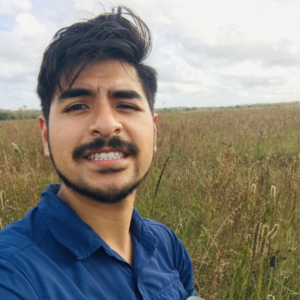 Luis Aguilar, Groundwork Ohio River Valley’s Green Team Program Director, has a passion for conservation and a love for prairies that began in Houston, TX where he is originally from. Luis studied Biology at the University of Houston – Downtown. Now in the Queen City of Cincinnati, he is continuing his education in Environmental Biosciences at the University of Cincinnati. With his background working as a Youth Leader, Environmental Educator and Applied Conservation Research Intern in Texas, he aims to protect our threatened flora & fauna and hopes to connect the next generation of conservation stewards to the great outdoors!
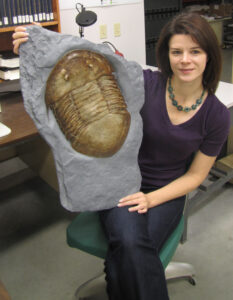 Dr. Brenda Hunda received her B. Sc. with Honors in Paleontology from the University of Alberta in 1997, her M. Sc. in Earth Sciences from the University of Alberta in 1999, and her Ph.D. in Earth Sciences from the University of California, Riverside in 2004. She is currently the Curator of Invertebrate Paleontology at the Cincinnati Museum Center and Adjunct Professor at the University of Cincinnati. Her position includes exhibit design, educational programming development, community outreach in the form of lectures and workshops, curating the largest collection of Upper Ordovician fossils in the world, developing a scientific research program that includes international travel, and playing in the one of the highest diversity fossil sea bottoms in North America.
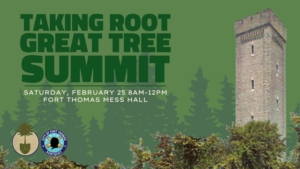 At this year’s Taking Root Great Tree Summit, the Lloyd is partnering with speakers from The Ohio State University Extension, Fort Thomas Forest Conservancy, and the Cincinnati Zoo. Hear about local initiatives addressing the tree crisis, catch a presentation by Lloyd Librarian Betsy Kruthoffer, and meet with tree experts and tree lovers for a new perspective on trees at this free event.