
Plants are brilliant chemists that produce everything from colors, flavors, and medicines. They can also create deadly toxins! Have you ever wondered why they produce such a dizzying array of compounds, and why they work on us like they do? Find out more when Dr. Eric Tepe explains about the hows and whys of plant toxins found in everything from potatoes and castor beans to beautiful rhododendrons and how these plants protect themselves through such lethal ways.
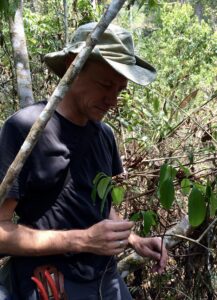 Dr. Eric Tepe is Associate Professor of Botany and curator of the Margaret H. Fulford Herbarium at the University of Cincinnati. His research focuses on plant systematics, including taxonomy, phylogenetics, biogeography, and diversification of “giant genera” – those with over 1,000 species such as Piper (Piperaceae) and Solanum (Solanaceae). He also studies evolution of ant-plant associations. He graduated from The Ohio State University with a double major in Botany and Spanish and went on to obtain his PhD in Botany at Miami University, Oxford, Ohio. A native to Ohio, Eric lived in Venezuela and Argentina as a child, and developed a passion for traveling. His research takes him frequently to Brazil, Costa Rica, Ecuador, or Panama where he is always on the lookout not just for plants.
 Barney L Lipscomb is the director of the Botanic Research Institute of Texas Press and Library and is the Leonhardt Chair of Texas of Texas Botany. After earning degrees from Cameron University (B.S. Biology) and University of Arkansas, Fayetteville (M.S. Botany), Lipscomb was the herbarium botanist and curator for Southern Methodist University in Dallas, Texas. He became the assistant editor of the botanical journal Sida, Contributions to Botany and co-founded Sida, Botanical Miscellany. Lipscomb has co-authored numerous books on Texas flora. Interested in researching poisonous plants, he actively serves on the board of consultants for the North Texas Poison Center.