
From 7:00 p.m. until 8:00 p.m.
At Lloyd Library & Museum
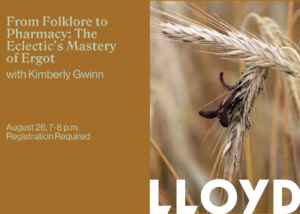 The ergot fungus (Claviceps purpurea) has a dark history, linked to St. Anthony’s Fire and the collapse of Peter the Great’s 1722 Ottoman campaign after ergot-infected rye poisoned soldiers and horses. Yet for centuries it was also used by midwives as pulvis ad partum (“powder for birth”), though misuse later earned it the name pulvis ad mortem (“powder for death”). Eclectic Medicine helped refine ergot into stable, reliable medicines through improved extraction methods. Today, ergot-derived compounds remain important treatments for migraines and postpartum hemorrhage, linking folklore with modern pharmacology.
Kimberly Gwinn is a Professor in the Department of Entomology and Plant Pathology at University of Tennessee. Her research explores the ecological roles of natural compounds in interactions among humans, animals, and the environment, with a focus on biopesticides from agricultural waste and microbial toxins in plant-based products. She teaches courses on medicinal plant and microbial products and is nationally recognized for advancing STEM education through undergraduate research.